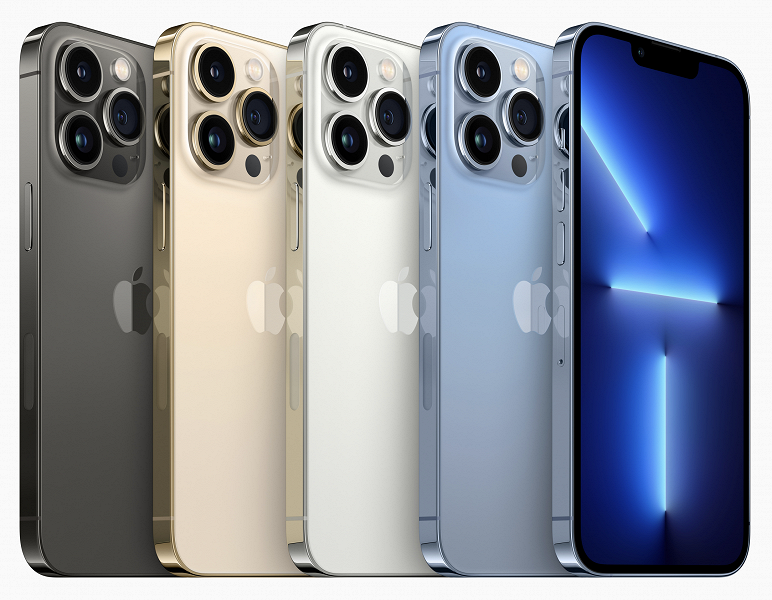
We have presented and analyzed the general information and all the details announced by Apple in our report on the results of the September presentation, so we will not repeat ourselves and will move on to testing. We will just remind you of the specifications of the new product to start with.
Since we did not have the iPhone 13 Pro Max for testing, we do not include its specifications in this list and in the table below, but in general, they are almost completely identical, except, of course, for the dimensions, display size, and battery capacity.
Technical Specifications of Apple iPhone 13 Pro
SoC Apple A15 Bionic (6 processor cores: 2 high-performance and 4 energy-efficient, 5 graphics cores, 16-core Neural Engine)
6.1" touch display, OLED, 2532×1170, 460 ppi, capacitive, multi-touch
RAM (according to Geekbench 5): 5.5 GB
Flash memory 128/256/512 GB / 1 TB
No support for memory cards
Cellular communication: UMTS/HSPA/HSPA+/DC-HSDPA (850, 900, 1700/2100, 1900, 2100 MHz); GSM/EDGE (850, 900, 1800, 1900 MHz), LTE Bands 1, 2, 3, 4, 5, 7, 8, 12, 13, 17, 18, 19, 20, 25, 26, 27, 28, 29, 30, 38, 39, 40, 41, support for Gigabit LTE, 5G
Wi-Fi 6 (802.11b/g/n/ac/ac/ax, 2.4 and 5 GHz, MIMO support)
Bluetooth 5.1, A2DP, LE
NFC (for Apple Pay only)
GPS with A-GPS, GLONASS, Galileo, and QZSS
Universal Lightning connector
Cameras: front (12 MP, 4K video at 30 fps, 720p at 240 fps) and rear modules 12 MP (4K video at 60 fps): wide-angle (f/1.5, 26 mm), telephoto (f/2.8, 77 mm) and ultra-wide (f/1.8, 13 mm, 120 degrees)
Face recognition using TrueDepth
Lithium-polymer battery 3095 mAh (unofficial information), non-removable
Support for Qi wireless charging
Support for MagSafe accessories
Dimensions 147×72×7.7 mm
Weight 203 g
IP68 protection
Operating system iOS 15
Let's compare the iPhone 13 Pro and iPhone 13 to understand how significant the difference is between them.
| Apple iPhone 13 Pro | Apple iPhone 13 | |
|---|---|---|
| Screen | 6.1", OLED, 2532×1170, 460 ppi | 6.1", OLED, 2532×1170, 460 ppi |
| SoC (processor) | SoC Apple A15 Bionic + Neural Engine system | SoC Apple A15 Bionic + Neural Engine system |
| Flash memory | 128/256/512 GB / 1 TB | 128/256/512 GB |
| RAM (according to Geekbench 5) | 5.5 GB | 3.6 GB |
| Communication | 5G, Gigabit LTE, Wi-Fi 802.11ax (Wi-Fi 6) | 5G, Gigabit LTE, Wi-Fi 802.11ax (Wi-Fi 6) |
| Rear cameras | 3 modules of 12 MP (video — 4K 60 fps): standard wide-angle, telephoto, and ultra-wide (120 degrees) | 2 modules of 12 MP (video — 4K 60 fps): standard wide-angle and ultra-wide (120 degrees) |
| Front camera | 12 MP (video — 4K 60 fps), FaceID recognition | 12 MP (video — 4K 60 fps), FaceID recognition |
| Fast charging | yes + MagSafe technology (wireless charging up to 15W, magnetic accessory connection) | yes + MagSafe technology (wireless charging up to 15W, magnetic accessory connection) |
| Battery, mAh (unofficial information) | 3095 | 3240 |
| Dimensions (mm) | 147×72×7.7 | 147×72×7.7 |
| Weight (g) | 203 | 174 |
Thus, the difference lies in the camera (additional module), the amount of RAM, and the maximum storage capacity (1 TB is only available in Pro versions). But the difference in the weight of the device is also interesting: the iPhone 13 Pro is 30 g heavier.
Packaging and Completeness
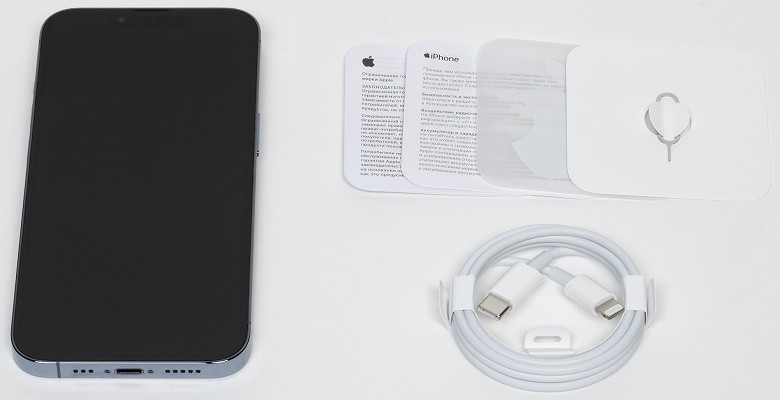
The packaging and completeness of the iPhone 13 Pro is completely identical to the iPhone 13. The smartphone comes in a compact box without plastic wrap, but with a protective paper tape that needs to be torn.
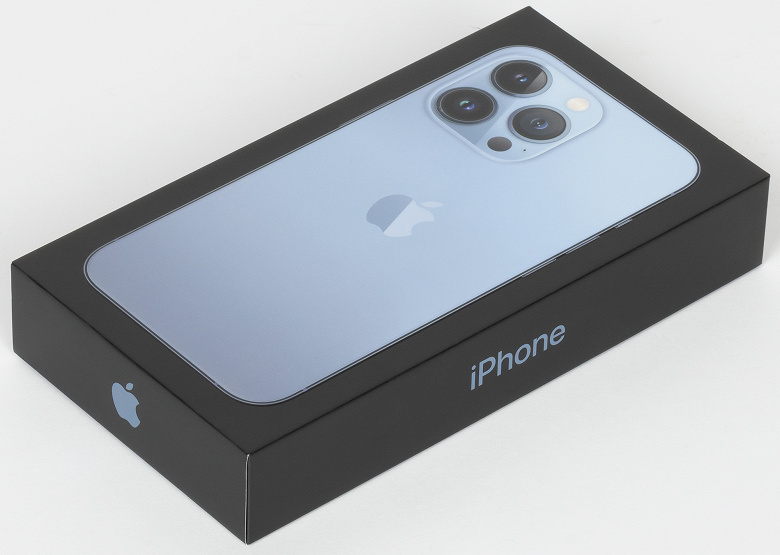
Inside, as before, there is a Lightning/USB-C cable, a sticker in the form of the Apple logo, and a tool for ejecting the SIM card.
Along with the new iPhones, new cases have also appeared for sale, which is quite logical and not just for marketing reasons. The thing is that the camera block is now slightly larger (we will talk about this in more detail later), so despite all the desire to use old cases with this year's models, it won't work.
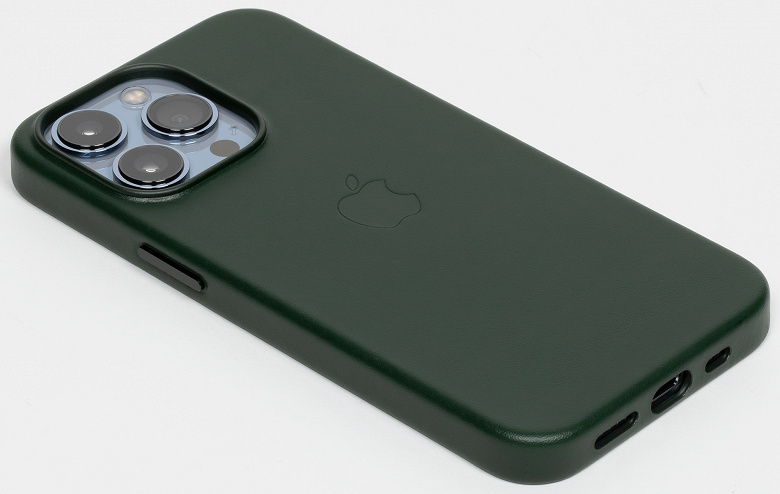
As before, silicone and leather cases are available in new colors. For example, we had the "green sequoia" option - a dark green with a slight brownish tint. However, its combination with the blue iPhone is a matter of taste; a graphite or silver body would probably be better suited. And the price is steep: almost 6 thousand. But the case itself is beautiful.
Design
The iPhone 13 Pro looks even more like its predecessor — simply because even the camera block, which changed slightly in the iPhone 13 compared to the iPhone 12, looks, at first glance, the same as a year ago.
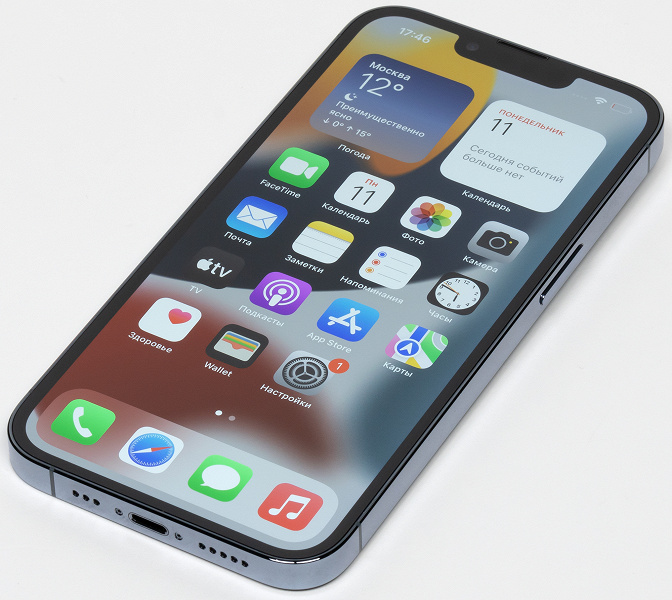
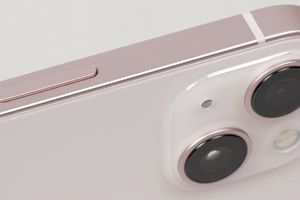
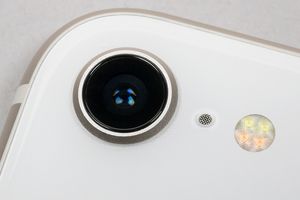
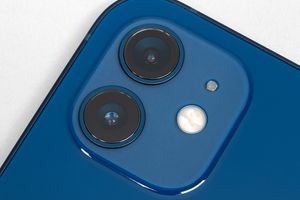
But there are still minor changes: first, the "notch" on the top edge — as with the iPhone 13, it has become smaller than in the previous generation. And secondly, the camera block is actually slightly larger, as are the camera modules themselves. We measured the glass area entirely and the camera lenses by the lens glass: the area size was 35 mm in the iPhone 13 Pro and 32 mm in the iPhone 12 Pro, while the lens openings were 13 and 11 mm respectively.
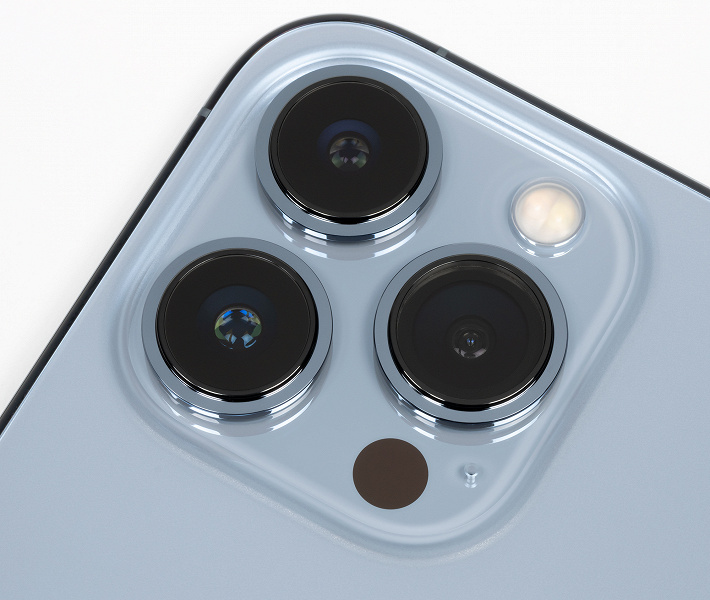
Of course, noticing such a difference in everyday life is practically impossible. And still, if you are used to the look of the previous generation model, you will occasionally catch yourself thinking that the cameras in the new iPhone are somehow too large.
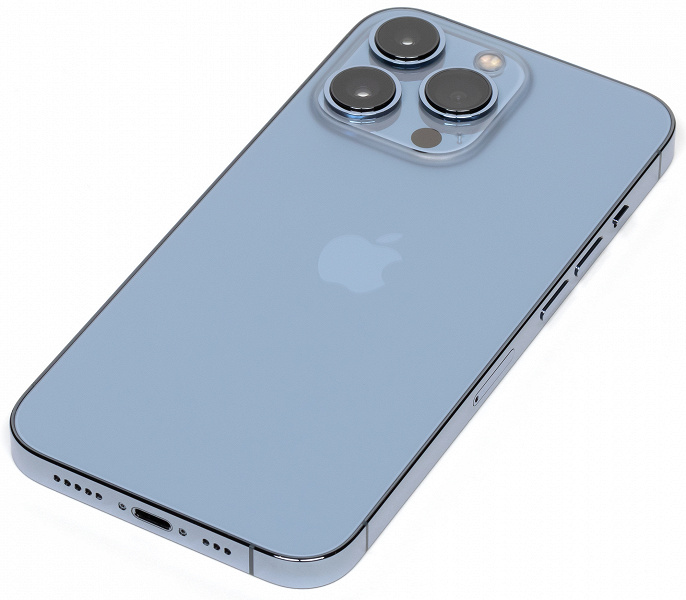
But if you still want those around you to probably recognize you as the owner of the iPhone 13 Pro, you should choose a model in the new color: "sky blue." Unlike last year's "Pacific Blue," it is lighter and has a grayish tint. Just in case, we remind you once again that the photos in the article do not quite accurately convey the shade, and if this is important to you, it is better to find an opportunity to get acquainted with the device in person before purchasing.
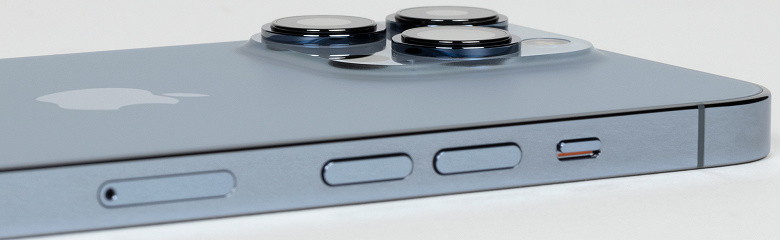
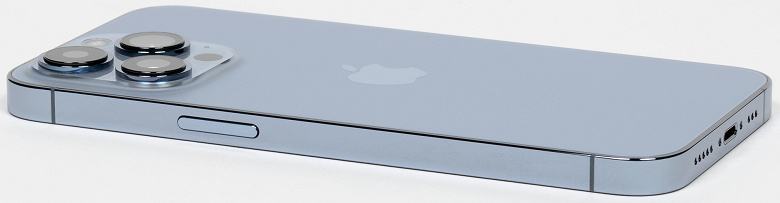
Otherwise, everything remains unchanged. The button layout is still the same: two separate volume buttons and a mute switch on the left edge, and there is the Nano-SIM card slot there as well. On the right edge, there is only the power button.
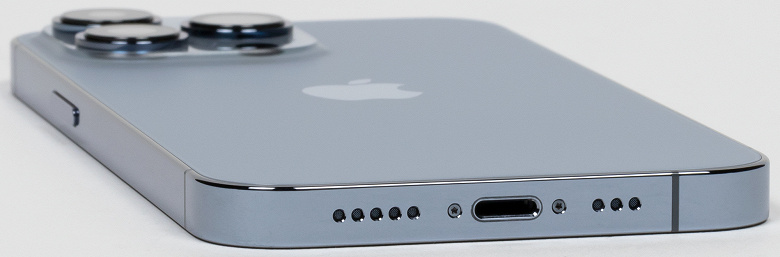
At the bottom — speakers and the Lightning connector, which Apple stubbornly does not want to abandon in its smartphones.
Well, and there is absolutely nothing at the top.
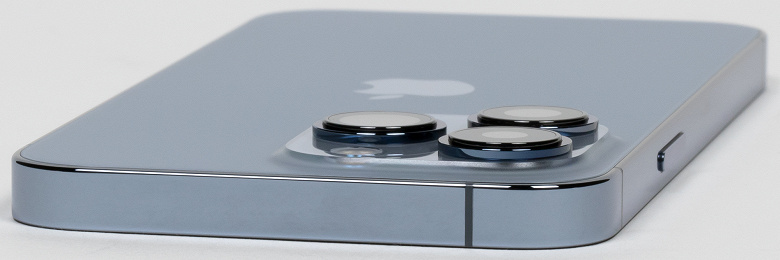
Our overall positive assessment of the design remains unchanged, although now there is no longer a wow effect. However, this does not negate the fact that we have a beautiful and convenient smartphone.
Screen
The front surface of the screen is made of a glass plate with a mirror-smooth surface, resistant to scratches. Judging by the reflection of objects, the anti-reflective properties of the screen are slightly better than those of the Google Nexus 7 (2013) (hereafter simply Nexus 7). For clarity, we provide a photo in which the white surface is reflected on the turned-off screens (on the left is the Nexus 7, on the right is the Apple iPhone 13 Pro, which can be distinguished by size):
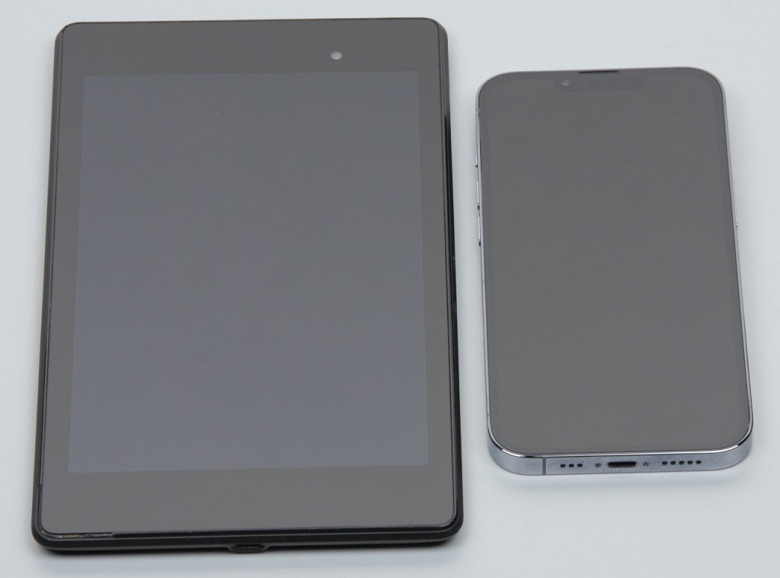
The screen on the Apple iPhone 13 Pro is slightly darker (brightness in the photos 107 against 113 in the Nexus 7). The two reflected objects on the Apple iPhone 13 Pro screen are very faint, indicating that there is no air gap between the layers of the screen (specifically between the outer glass and the matrix surface). Due to the fewer boundaries (type glass/air) with significantly different refractive indices, such screens look better in conditions of intense external illumination, but their repair in case of cracked outer glass is much more expensive, as the entire screen has to be replaced. The outer surface of the screen has a special oleophobic (oil-repellent) coating (effective, better than in the Nexus 7), so fingerprints are removed much more easily and appear at a slower rate than with regular glass.
With manual brightness control and when displaying a white field on the entire screen, the maximum long-term brightness value was about 820 cd/m², and in very bright light, it increases to 1020 cd/m² (claimed up to 1000 cd/m² in normal mode and up to 1200 cd/m² in HDR mode), minimum - 1.9 cd/m². The maximum brightness is very high, and considering the excellent anti-reflective properties, reading even on a sunny day outdoors will be at a good level. In the dark, the brightness can be reduced to a comfortable level. Automatic brightness adjustment is available via the light sensor (located below the front speaker grille in the notch area), which is enabled by default. In automatic mode, when external lighting conditions change, the screen brightness increases and decreases. The operation of this function depends on the position of the brightness slider: the user sets the desired brightness level for the current conditions. If nothing is changed, then in complete darkness, the brightness decreases to 6 cd/m² (very dark), in conditions of illuminated artificial light office (about 550 lx) the screen brightness is set to 120 cd/m² (acceptable), in very bright surroundings (illuminance over 20000 lx) it rises to 1020 cd/m² (to the maximum, and needed). The result did not completely satisfy us, so in the dark we slightly moved the brightness slider up (in the quick access menu), and for the three specified conditions, we obtained 20, 120, and 1020 cd/m² (perfect). It turns out that the auto-brightness function works adequately, and the brightness adjustment can be tailored to the user's requirements. At any brightness level, there is modulation at a frequency of 480 Hz.